
Choosing a Leonberger is much more than adopting a dog. It means welcoming a companion who will share your daily life for many years.
It is therefore perfectly normal to have questions about their temperament, health, growth, diet and the responsibilities that come with adopting a giant-breed dog.
At Corleone Leonbergers, we believe a successful adoption begins with a well-informed family. Here are the answers to the questions future adopters ask us most often.
1. Our kennel and our philosophy
Where is the Corleone Leonbergers kennel located?
Our kennel is located in the heart of the Laurentians, in the Mont-Tremblant region, north of Montreal.
We have nearly 30 years of experience in dog breeding, with a special passion for the Leonberger.
Why choose Corleone Leonbergers?
Our philosophy rests on three core priorities: health, temperament and respect for the breed standard.
We pay special attention to the selection of our breeding dogs, to genetic diversity and to the development of our puppies.
We aim to produce Leonbergers that have not only the physical qualities sought in the breed, but also the balanced character that makes them wonderful family companions.
How can you recognize a responsible breeder?
A responsible breeder should be transparent about their breeding practices, the health testing of their breeding dogs and the conditions in which their puppies are raised.
They should also know the hereditary risks associated with their breed, be able to explain their breeding choices and offer support to families.
The number of litters per year is not enough on its own to judge the quality of a kennel. What matters are the practices, the care and respect for animal welfare.
Do your dogs take part in dog shows?
Yes. Dog shows play an important role in our breeding program.
Several Corleone Leonbergers have distinguished themselves in Canada and internationally.
Shows make it possible to assess how well dogs conform to the breed standard. However, championship titles never replace a selection based on health, temperament and genetics.
Why do you import Leonbergers from other countries?
We work with different international bloodlines to broaden our selection options and promote genetic diversity.
A dog’s geographic origin does not guarantee its quality. We assess each breeding dog on its health, history, pedigree, temperament and conformity to the standard.
2. The birth and socialization of our puppies
Where are your puppies raised?
Our puppies are born and raised in our home, alongside our family.
From their very first days, they enjoy attentive human presence. As they grow, they are gradually introduced to everyday sounds, different kinds of handling and experiences suited to their age.
This approach supports their development and helps them adapt to their future family life.
Can we come and see the puppies before adoption?
Yes. We are happy to welcome future families by appointment, but only once the puppies have received their first vaccination.
The resurgence of certain infectious canine diseases, parvovirus in particular, requires us to follow a stricter health protocol to protect our puppies.
Some diseases that had become much less common are now a serious concern for breeders. Since young puppies are especially vulnerable, we prefer to take every necessary precaution.
No visits are therefore allowed before the first vaccine is given. This is an essential preventive measure for our kennel, even though a first vaccination does not yet provide complete protection.
These visits remain a special time to get to know each other, talk about the breed, answer your questions and show you where our dogs are raised.
The health and safety of our puppies come first. Thank you for your understanding and cooperation.
Can we choose a male or a female?
Yes, absolutely! You choose the sex of your future companion according to your preference.
We then help you choose the puppy that will best suit your family, your environment and your lifestyle.
Since each puppy has its own personality, we take the time to observe its temperament, behaviour and development to guide you toward the one that best matches your expectations.
Our goal is to respect your choice while helping you find the ideal companion for your family.
At what age do puppies leave the kennel?
Our puppies can usually join their new family from eight weeks of age, when their development, health and readiness allow.
Each departure is planned to make the transition as smooth as possible.
3. Reservation, price and adoption
What is the price of a Leonberger puppy at Corleone?
To find out the price of our Leonberger puppies, we invite you to always contact us directly.
The price of a puppy reflects, among other things, the work of genetic selection, health testing of the breeding dogs, veterinary care, food, socialization and all the time devoted to its development.
Our commitment does not end when the puppy leaves: we also support our families throughout their companion’s life.
Feel free to contact us for our prices and all the information about adopting a puppy from Corleone Leonbergers.
How do I reserve a puppy?
To get started, we invite you to fill out our adoption questionnaire. It helps us get to know your family, your home and your plans.
You can reach us through our contact form, by email at perronlucie63@gmail.com or by phone at 819 681-9663.
We will take the time to discuss your adoption plans, your experience with dogs and your family environment.
A $500 reservation deposit is required, according to the terms of our contract.
You can also visit our “ Our future litters ” page to discover our upcoming breeding plans.
What is included with your puppy?
At Corleone Leonbergers, adopting a puppy does not end when it leaves our kennel. We want to offer each family personalized support and a relationship of trust that continues over the years.
Our puppies come with their registration, the vaccinations scheduled before departure and the documents related to their follow-up.
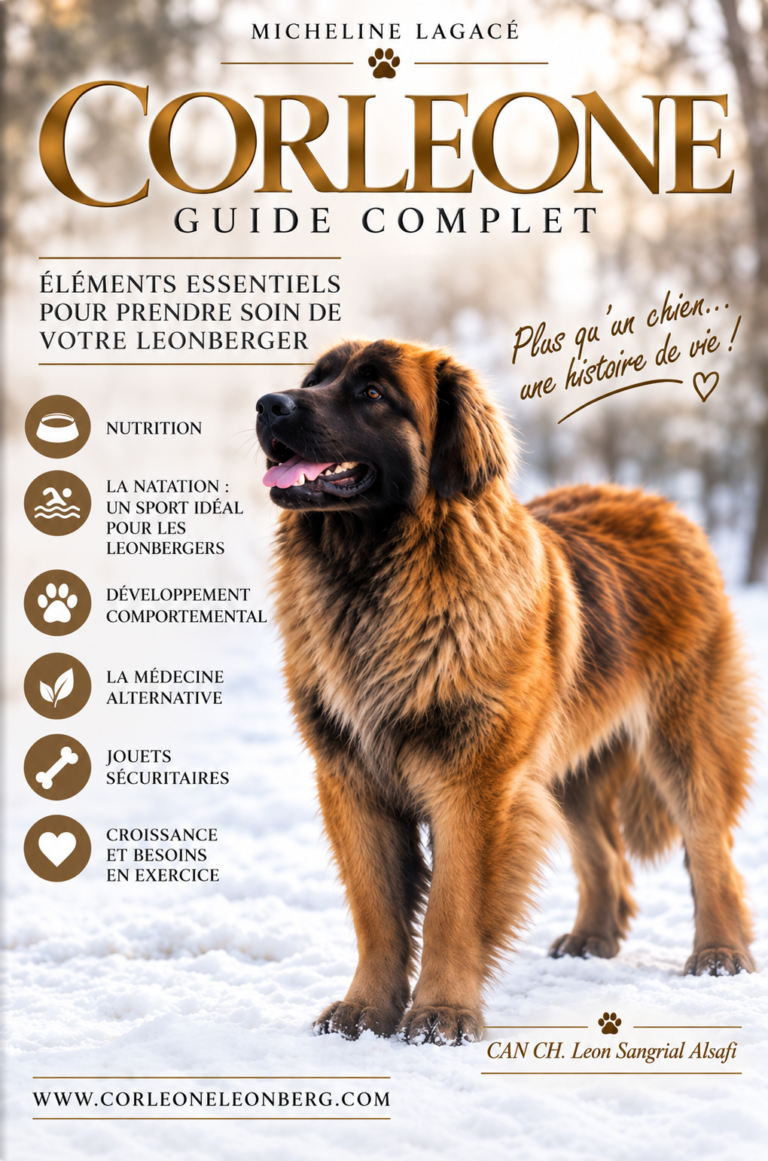
Each family also receives our illustrated e-book “Corleone — Guide complet” (written in French), designed especially for new adopters. This guide contains a wealth of information on the Leonberger’s diet, growth, health, training, care and well-being.
Details regarding microchip identification, deworming, the veterinary exam and the other items provided at departure are specified at the time of adoption.
Support throughout your Leonberger’s life
Our commitment does not end when your puppy leaves our home.
We remain available, to the best of our knowledge and ability, to advise you throughout your companion’s life, particularly on training, behaviour, socialization and adapting to different situations.
If you encounter behavioural difficulties, we will take the time to listen, guide you and suggest possible solutions whenever we can. Some situations may, however, require the help of a qualified dog trainer, a behaviour specialist or a veterinarian.
At Corleone, you are not simply adopting a puppy: you are joining a family that remains there to support you, as much as possible, throughout its life.
Can I buy a puppy for breeding?
As a general rule, no. Our puppies are mainly intended as companions and are not sold with breeding rights, particularly in Quebec.
This decision is part of our breeding philosophy and aims to protect our bloodlines, preserve our genetic selection work and maintain strict control over the use of our breeding dogs.
We devote a great deal of time, research and resources to developing our bloodlines. We therefore want to make sure that any breeding meets our standards for health, temperament, genetic diversity and conformity to the Leonberger standard.
On rare occasions, however, we may consider a special agreement with a carefully selected breeder. Each request is then reviewed individually, and strict contractual conditions may apply.
Our goal is not to multiply breeding dogs, but to preserve the quality, health and future of the Corleone bloodlines.
Breeding is a serious responsibility, and we want our selection work to be respected and carried on with the same rigour.
Do you deliver puppies outside Quebec?
Transport or adoption outside Quebec must be discussed directly with our kennel.
Health and administrative requirements, as well as transport conditions, vary by destination.
4. Health, genetics and guarantees
What health tests do you perform on your breeding dogs?
Health is a priority in our breeding program.
We place particular importance on screening for orthopedic problems, notably hip and elbow dysplasia, as well as for known hereditary diseases in the Leonberger.
Available results and tests can be discussed with families.
Why do you place so much importance on genetics?
Because a beautiful dog is not necessarily a genetically healthy dog.
A pedigree full of champions can be impressive, but titles do not reveal all the hereditary risks present in a bloodline.
We look at family relationships, health history, the characteristics of the breeding dogs and genetic diversity.
Our goal is to make thoughtful breeding decisions based on as much information as possible.
Do two healthy parents guarantee healthy puppies?
No. No serious breeder can guarantee that a puppy will never develop a disease.
Even when the parents have excellent health results, certain conditions can appear in their offspring.
Our responsibility is to reduce known risks as much as possible through rigorous selection.
Do you offer a health guarantee?
Yes. Our puppies come with a contract that includes a one-year guarantee covering certain hereditary or congenital diseases, according to the conditions and exclusions set out in the contract.
We encourage families to read their contract carefully and to ask all their questions before adoption.
Why don’t you always breed the same males with the same females?
We want to maintain a diversified breeding program and avoid relying on too small a number of genetic combinations.
Each pairing must be assessed based on the health, temperament, standard and relatedness of the breeding dogs.
Repeating a pairing is not automatically bad, but it must be justified by a rigorous assessment.
5. The Leonberger’s temperament
Is the Leonberger a good dog for children?
The Leonberger is generally known for its gentle, affectionate and patient temperament.
However, its large size requires constant supervision during interactions with young children.
As with all breeds, training, socialization and respect for everyone’s limits are essential.
Can it live with cats or other dogs?
Yes, absolutely! The Leonberger can live very well with cats and other dogs, especially when it has been well socialized from a young age.
At Corleone Leonbergers, all our puppies get used to cats from a very young age, since we have cats of our own who share our family home.
Our puppies also grow up around our adult dogs, which allows them to become familiar with interactions between dogs and gradually learn canine communication.
This early socialization is an excellent starting point to help them settle into a family that already has other animals.
However, every dog has its own personality. A gradual introduction, careful supervision and respect for each animal’s needs remain essential for a harmonious life together.
Our goal is to prepare our puppies to become balanced companions, able to adapt to different family settings, including those that already have cats or other dogs.
Is it a good guard dog?
The Leonberger has a naturally impressive stature, which can be a deterrent.
However, it is not sought mainly for guarding or protection.
The breed standard favours a balanced, confident, friendly dog with no unwarranted aggression.
Is it easy to train?
The Leonberger generally responds well to positive, consistent and respectful training.
Its intelligence and attachment to its family make learning easier when the methods are suitable.
Because it becomes a very powerful dog, good habits must be taught from a very young age.
Does the Leonberger cope well with being alone?
The Leonberger is very attached to its family.
It enjoys human company and should not regularly be left alone for very long periods without preparation or appropriate stimulation.
Gradually learning to be alone is important from the moment it arrives home.
6. Growth, diet and care
What diet do you recommend?
We recommend a complete and balanced diet suited to the needs of large- and giant-breed puppies.
The Leonberger’s growth must be monitored carefully to avoid overfeeding and to maintain a healthy body condition.
Our families receive recommendations to ease food transitions and support their puppy during its growth.
At what age does a Leonberger reach its adult size?
The Leonberger grows a great deal during its first year.
Even as it approaches its adult size, its muscle development and physical maturity can continue until about two or three years of age.
It is therefore important to respect its pace of development.
Should exercise be limited during growth?
It is important to adapt activities to the puppy’s age and development.
We encourage free play, suitable walks and varied experiences, while avoiding forced efforts, repetitive exercises and overly intense activities.
Does the Leonberger shed a lot?
Yes! The Leonberger has an abundant double coat and goes through heavy shedding periods.
Regular brushing helps remove dead hair, prevent tangles and keep its magnificent coat in good condition.
What is a Leonberger’s life expectancy?
The Leonberger is a giant breed whose life expectancy is generally shorter than that of small breeds.
Many Leonbergers live about 8 to 10 years, but longevity varies from one dog to another.
Proper veterinary follow-up, a balanced diet, good physical condition and attentive care all contribute to their quality of life.
Can a Leonberger live in an apartment?
The size of the home is not the only thing to consider.
A Leonberger can adapt to different environments if its needs for exercise, companionship, comfort and stimulation are met.
However, you must take into account its size, its weight, stairs and the practical constraints of living with a giant dog.
7. Bringing your puppy home
What should we prepare before it arrives?
We recommend providing a comfortable resting area, suitable bowls, appropriate food, safe toys, a leash, a collar and a calm environment to ease its adjustment.
Our guide contains many practical tips to prepare for this important step.
Do you provide a guide?
Yes, and we are especially proud of it!
We created our own illustrated e-book, “Corleone — Guide complet” (written in French), to support families through the different stages of their Leonberger’s life.
The book covers, among other things, diet, growth, care, toys, accessories, bowls, prevention and various topics related to the dog’s well-being.
It represents a significant amount of research, writing and design work.
It is given to families who adopt a puppy from Corleone. People outside our kennel who would like a copy can purchase it for $10.
Are you still available after the adoption?
Always!
Our support does not end when the puppy leaves our home.
We remain available to advise our families on diet, growth, training and the different stages of their companion’s life.
We also love receiving news, photos and videos of our Leonbergers over the years.
For us, every puppy that leaves our kennel remains part of the big Corleone family.
Have another question?
Every family is different, and every adoption plan deserves special attention.
Don’t hesitate to contact us. We will be happy to talk with you and help you decide whether the Leonberger is the right companion for you.
Email: perronlucie63@gmail.com
Phone: 819 681-9663
Corleone Leonbergers — More than a dog, a family.